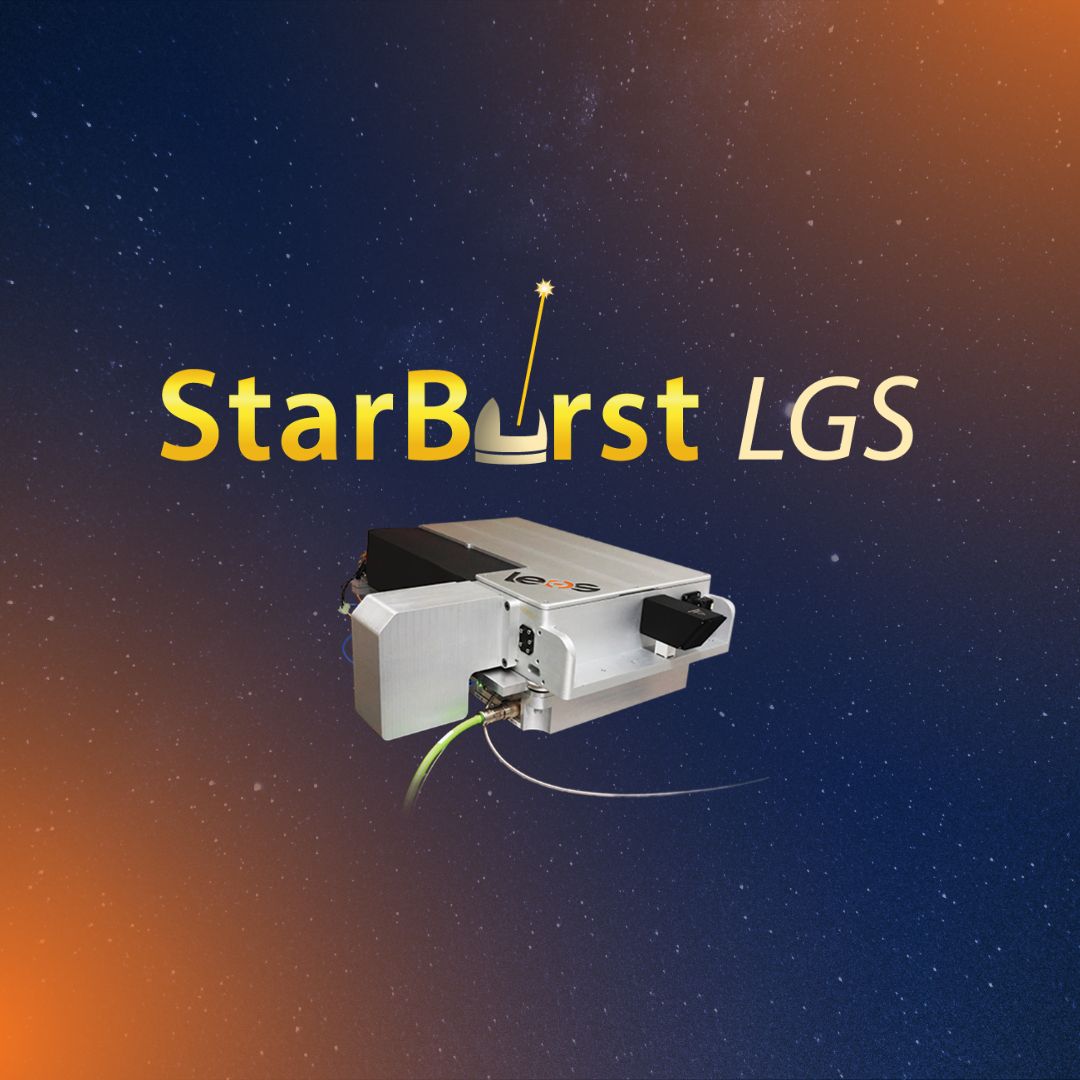
The StarBurst LGS combines LEOS' innovative nonlinear photonics expertise with MPBC's patented high-power Raman fiber amplifier (RFA) technology to deliver a robust, maintenance-free laser solution for next-generation adaptive optics.

Designed for demanding astronomical and optical ground station telescope environments, StarBurst LGS provides exceptional beam quality, absolute wavelength stability, and a scalable architecture for future increases in output power.

RFA-based LGS offer enhanced performance, operational simplicity, reliability, and low maintenance compared to earlier LGS technologies (dye lasers and bulk optics solid-state lasers). In an RFA LGS, a narrow-band seed at 1178 nm is amplified in a single-mode optical fiber and then frequency doubled to 589 nm.
MPBC has advanced narrow-band RFA technology, pioneered by ESO, to unprecedented power levels by overcoming the challenge of suppressing stimulated Brillouin scattering (SBS).
MPBC’s advanced RFA design also utilizes an all-polarization-maintaining (PM) fiber architecture. To power the RFA, a high-power Fiber Laser Pump Module (FLPM) based on two PM fiber lasers—at 1064 nm and 1120 nm—has been developed. This innovative two-laser setup also enables the option of utilizing MPBC's patented Remote Pump Delivery technology, separating the FLPM from the compact RFA for enhanced flexibility in deployment.
Our complete StarBurst LGS system is designed for adaptive optics systems not only for astronomical telescopes but also for emerging applications such as Optical Ground Stations for satellite laser
communications and space debris tracking.
The 1178-nm RFA technology in the StarBurst LGS is based on MPBC’s earlier 40-W RFA systems which have been deployed in 22-W, 589-nm guide star systems by all the major 8-10 m ground-based VIS/IR astronomical telescopes around the world. They have been widely acclaimed for their consistent high performance, low maintenance, ease of use and reliability.
Recognizing the need for higher-power LGS, especially for laser satellite communications Optical Ground Stations (OGS), we have scaled our RFA systems to a record output power of 130 W, enabling LGS outputpowers more than 75 W at 589 nm. This unprecedented power level unlocks the opportunity for daytime
operation of adaptive optics.
In addition, MPBC's patented Remote Pump Delivery technology allows the electronics cabinet to be located more than 30 m from the laser head, which includes the RFA. These enhancements create opportunities for smaller telescopes and new applications.

MPBC is constantly refining its LGS technologies, with a focus on scalability, suppressing SBS, and remote pump delivery. Our ongoing efforts to optimize efficiency, reduce costs, and explore new applications, will ensure that we remain at the forefront of this exciting industry.